
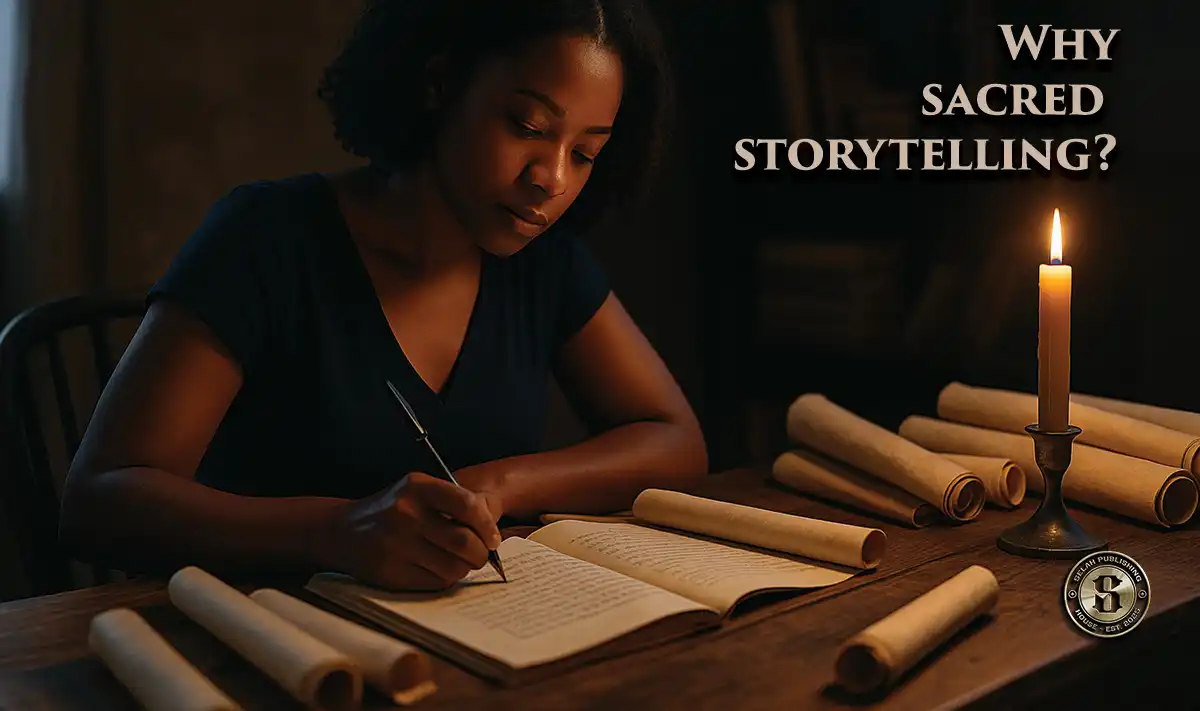
Sacred Storytelling as Devotion: Writing in the Echo of Covenant
There’s a kind of writing that doesn’t begin with plot.
It begins with reverence.
At Selah Publishing, we don’t tell stories just to entertain. We tell them to remember. To reframe. To recover something holy. Our stories are not revisions of Scripture—they are reflections of the sacred pattern within it.
We call it *sacred storytelling*.
It’s slow. It listens. It waits.
It enters the tent of memory with bare feet.
Sacred storytelling is not the same as biblical fiction. It doesn’t seek to “fill in the blanks” or decorate the gaps between verses. It seeks to honor the atmosphere of the text. To echo the tone of the Spirit. To imagine—but only with reverence.
When I write a scroll, I’m not trying to explain what happened.
I’m trying to kneel beside it. To hear what the Spirit may still be whispering through it.
This kind of writing is devotional.
It’s prophetic.
It’s priestly.
It begins with prayer.
Often silence. Often tears.
Sometimes fasting.
And always awe.
I write like a scribe—not a novelist.
I write with a listening posture, not a clever pen.
I ask the characters what they remember, what they regret, what they could not speak in their own time.
When Joseph stands silent in the dungeon, I don’t imagine his escape.
I ask what truth found him there.
When Simeon burns with fury, I don’t soften the scene. I let the pain speak—and then I ask where the healing might begin.
Sacred storytelling doesn’t rush.
It allows time for grief.
It honors the space between words.
It knows that sometimes the most holy line is the one left unsaid.
I believe fiction can be faithful.
Not because it replaces Scripture—but because it draws us back to it.
It reminds us that covenant is personal. That legacy is fragile. That memory matters.
At Selah, we use story as a form of devotion.
Every scroll is a kind of prayer.
Every flame-sight is a kind of lament.
Every silence is an invitation to ask what the Spirit still sees in the old path.
You don’t need to agree with every interpretation.
But if the story draws you closer to the covenant…
If it stirs something sacred in your soul…
Then maybe it has done its work.
This is not entertainment.
This is remembrance.
This is devotion shaped like a narrative.
This is worship in the form of a scroll.